

The article Newest Cryptocurrency to Invest In is a comprehensive guide that explores the fast‑changing landscape of digital assets in 2026, helping readers understand which projects stand out and why. It highlights the most promising new cryptocurrencies, from those driving Layer 2 scalability and cross‑chain liquidity to tokens pioneering quantum‑resistant security and AI‑powered trading ecosystems. Beyond showcasing innovation, the piece emphasizes the importance of evaluating tokenomics, community adoption, and regulatory compliance, giving investors practical tools to separate hype from genuine opportunity.
Written in a clear and approachable style, the article blends expert insights with relatable anecdotes, making complex topics accessible to both beginners and seasoned traders. Readers will gain a balanced perspective on the opportunities for high returns alongside the risks of volatility, liquidity traps, and speculative bubbles, ensuring they can make informed decisions. By focusing on long‑term strategies and the future outlook of tokenized assets, stablecoins, and Web3 ecosystems, the article positions itself as a trusted resource for anyone considering whether the newest cryptocurrencies deserve a place in their portfolio.
Table of Contents:
- Introduction: Why Invest in the Newest Cryptocurrency
- Current Crypto Market Trends 2026
- Key Innovations in New Cryptocurrencies
- Layer 2 Scalability Solutions Reducing Fees and Boosting Speed
- Cross‑Chain Interoperability for Unified Liquidity
- Quantum‑Resistant Cryptocurrencies Securing the Future of Blockchain
- AI‑Powered Crypto Projects Driving Automation and Predictive Trading
- Evolution of Meme Coins into Utility‑Driven Assets
- Comparison of Key Innovations in New Cryptocurrencies
- Best New Cryptocurrencies to Invest in 2026
- Bitcoin Hyper (HYPER) – Fast Layer 2 Bitcoin Transactions
- LiquidChain (LIQUID) – Cross-Chain Liquidity Powerhouse
- Maxi Doge (MAXI) – Meme Coin with Gamified Staking
- BMIC Token – Quantum-Resistant Wallet Infrastructure
- Divine Ray (DRC) – Blockchain for Spiritual and Social Communities
- CoinDepo (COINDEPO) – Governance and Staking Token with High APR
- Comparison of Best New Cryptocurrencies in 2026
- Best New Cryptocurrencies to Invest in 2026 – Quick Rankings
- How to Evaluate the Newest Cryptocurrencies
- Challenges and Risks in New Crypto Investments
- Future Outlook for New Cryptocurrencies
- Conclusion: Should You Invest in the Newest Cryptocurrency?
- FAQs: Newest Cryptocurrency to Invest In (2026)
- What makes new cryptocurrencies in 2026 different from older ones?
- Are new cryptocurrencies riskier than established ones?
- How do I evaluate whether a new cryptocurrency is worth investing in?
- What role does regulation play in new crypto investments?
- Can new cryptocurrencies really deliver high ROI in 2026?
- What are the biggest opportunities in new cryptocurrencies right now?
- How should I build a strategy around new crypto investments?
Introduction: Why Invest in the Newest Cryptocurrency
Newest Cryptocurrency Investment Opportunities in 2026
If you’ve been around crypto for a while, you know the thrill of spotting a project before it explodes. In 2026, that thrill is alive and well. Over 540,000 new tokens were launched on Ethereum, Solana, and Base in just the first two months of the year, although most fizzled out quickly.
The upside is clear: the right pick can deliver outsized returns compared to established coins. Projects like Bitcoin Hyper, LiquidChain, and BMIC Token are already making waves by solving real problems such as transaction speed, cross-chain liquidity, and quantum security.
For investors, this means there are genuine opportunities to diversify portfolios with assets that could become tomorrow’s household names.
How Early Adoption of New Crypto Projects Can Maximize ROI
Early adoption has always been the golden ticket in crypto. Think back to those who bought Ethereum under $10 or Solana before it hit mainstream exchanges. The same principle applies today. Getting in during presale or shortly after launch often means lower entry prices, higher staking rewards, and access to exclusive community perks.
Of course, it’s not without risk; many projects fail; but the potential for 10x or even 100x returns is what keeps traders scanning presale lists and Discord channels late at night. Personally, I’ve seen friends turn modest investments into life-changing gains simply because they were willing to take a chance early.
Why Investors Are Shifting Focus from Established Coins to Emerging Tokens
Bitcoin and Ethereum remain the backbone of the crypto world, but they’re no longer the only game in town. Investors are shifting toward emerging tokens because they offer something fresh: new narratives, innovative technology, and untapped markets. For example, meme coins like Maxi Doge are evolving into utility-driven ecosystems, while AI-powered projects are building predictive trading platforms.
Meanwhile, institutional investors are pouring money into ETFs and tokenized assets, which creates space for smaller, agile projects to thrive. The appeal is simple: established coins may be safer, but they rarely deliver the explosive growth that new cryptocurrencies can.
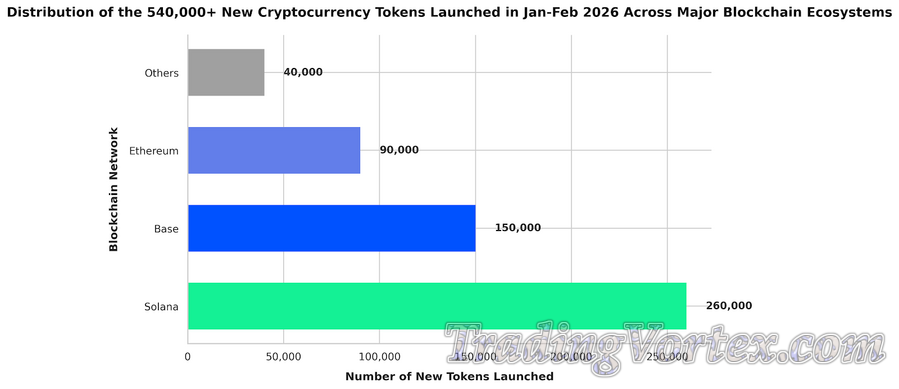 Visualizing the 2026 Token Explosion.
How to Understand and Use This Visual:
As you navigate the fast-moving landscape of emerging cryptocurrencies, this chart serves as a structural map of where the massive wave of over 540,000 early 2026 token deployments is actually taking place.
♦ Identify the Activity Hotspots: The length of each bar represents the total volume of new project launches on that specific network. As you can see, Solana and Base are heavily dominating the market share for new launches. If you are hunting for ultra-early-stage micro-cap projects or high-risk, high-reward plays, these two ecosystems are where the highest concentration of developer activity is occurring.
♦ Evaluate Ecosystem Characteristics: While Ethereum hosts a smaller raw quantity of new tokens, it remains the historic hub for large-scale institutional capital. The sheer volume on Solana and Base highlights their ultra-low transaction fees, making them the preferred playground for rapid testing, meme ecosystems, and fast-moving agile protocols.
♦ Inform Your Diligence Strategy: Use this data to calibrate your risk management. Because the barrier to entry for launching tokens on high-velocity networks like Solana and Base is incredibly low, the "noise" is exceptionally high. When exploring these specific sectors, you should apply double the standard due diligence to weed out fleeting projects from those with sustainable tokenomics.
Current Crypto Market Trends 2026
Crypto Market Trends and Investor Sentiment
After a rocky finish to 2025, the mood in 2026 feels noticeably lighter. The Fear & Greed Index has climbed to its highest level in months, signaling that traders are regaining confidence. Prices remain volatile, but the overall market capitalization is holding steady between $2.4 trillion and $2.7 trillion, supported by ETF flows and institutional participation. Retail investors are back in the game too, buzzing on social media about entry points and portfolio strategies. If you’ve ever felt the FOMO kick in when everyone else seems to be buying, you’ll understand why sentiment matters so much: it can turn hesitation into a buying frenzy almost overnight.
The difference this year is that optimism feels more grounded. Instead of chasing hype alone, investors are paying closer attention to fundamentals like token utility, developer activity, and regulatory clarity. This shift suggests that the market is maturing, even if the occasional meme coin frenzy still grabs headlines.
Institutional Adoption and Global Regulatory Updates
One of the biggest shifts this year is that institutional adoption is no longer just a narrative: it’s visible in balance sheets and ETFs. Corporate crypto holdings are projected to exceed $250 billion by the end of 2026, more than doubling from last year. Over 100 crypto-linked ETFs are expected to launch in the United States alone, absorbing supply and stabilizing liquidity. Pension funds and insurance companies are dipping their toes in as well, signaling that crypto is becoming part of mainstream portfolio diversification.
On the regulatory side, several regions have introduced clearer frameworks, making compliance easier and boosting investor confidence. Europe’s MiCA framework is setting standards for transparency, while Asian markets are experimenting with sandbox environments for blockchain innovation.
For traders, this means the market is becoming more structured, with fewer wild swings driven purely by retail speculation. Still, regulatory differences across countries remain a challenge, and investors need to stay alert to shifting rules that can impact liquidity and access.
Growth of Stablecoins and Tokenized Assets
Stablecoins are no longer fringe: they’re becoming the backbone of everyday payments. From remittances to corporate treasury operations, stablecoins are quietly powering faster settlements and global interoperability. The total stablecoin market cap has surpassed $200 billion, with USDC and USDT leading the charge, but newer entrants are carving niches in regional markets.
At the same time, tokenization of real-world assets is emerging as the next big wave. Tokenized treasuries, funds, and commodities are solving problems like settlement delays and capital inefficiency, making them attractive to institutions. BlackRock and other asset managers are piloting tokenized funds, while banks are exploring tokenized bonds for faster cross-border transactions. This shift reframes crypto from being just a speculative asset into a practical financial infrastructure, bridging traditional finance with blockchain innovation.
Impact of Web3 Adoption on New Cryptocurrencies
Web3 adoption is accelerating, and it’s giving new cryptocurrencies a chance to shine. Decentralized applications are moving beyond hype into real-world use cases, from gaming to social media to supply chain management. For emerging tokens, this means they can plug directly into ecosystems where users are already active.
The combination of AI integration, decentralized finance (DeFi), and Web3 platforms is creating fertile ground for new projects to gain traction quickly. Imagine a token that powers an AI-driven trading assistant inside a DeFi platform, or one that fuels a decentralized social network where creators earn directly from their communities. These are no longer futuristic ideas: they’re happening now.
For investors, the takeaway is clear: the newest cryptocurrencies that align with Web3 adoption trends stand a better chance of long-term survival. If you’ve ever wondered why some coins skyrocket while others fade, it often comes down to whether they’re riding these broader adoption waves.
Comparison of Current Crypto Market Trends 2026
| Trend | Key Highlights | Impact on Investors | Opportunities | Risks |
|---|---|---|---|---|
| Investor Sentiment | Market cap steady at $2.4–$2.7T; Fear & Greed Index rising | Renewed confidence, more retail participation | Early entry into promising projects | Volatility can still trigger sudden downturns |
| Institutional Adoption | Corporate holdings projected >$250B; 100+ ETFs in US | Stronger liquidity and legitimacy | Safer long-term exposure, mainstream acceptance | Regulatory differences across regions |
| Stablecoins Growth | Market cap >$200B; powering payments and treasury ops | Reliable medium for transactions | Everyday use cases, cross-border payments | Centralization concerns, regulatory scrutiny |
| Tokenized Assets | Treasuries, funds, commodities moving on-chain | Bridges traditional finance with blockchain | Faster settlement, efficiency gains | Adoption depends on institutional trust |
| Web3 Adoption | Gaming, social media, DeFi integration | Expands utility for new tokens | Early projects gain traction quickly | Tech maturity and user onboarding challenges |
This section captures the pulse of the crypto market in 2026: optimism returning, institutions leading the charge, stablecoins and tokenization reshaping finance, and Web3 opening doors for new tokens. It’s a reminder that while volatility is still part of the game, the foundations of crypto are stronger than ever.
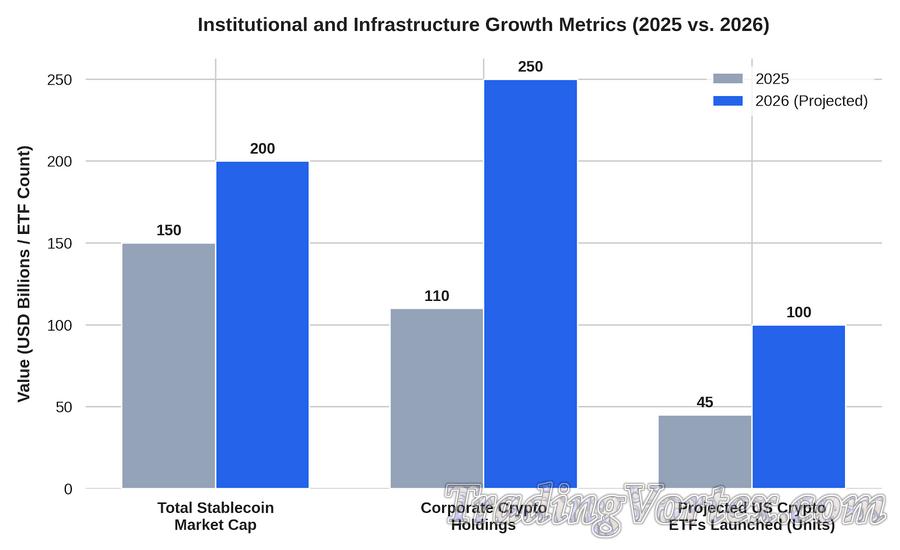 Institutional Momentum and Infrastructure Scale: Comparing Key Crypto Market Metrics from 2025 to 2026.
Understanding This Visual:
This side-by-side bar chart tracks the tangible shifts driving the 2026 crypto market maturation described above. By comparing the previous year's baselines (grey bars) against the 2026 milestones (blue bars), you can easily visualize exactly where the momentum is concentrated:
♦ Stablecoin Liquidity: Notice how the backbone of daily global payments has breached the $200 billion mark, reflecting deepened reliance on digital dollars for faster settlements and cross-border transactions.
♦ Corporate Commitment: The most dramatic shift occurs in corporate balance sheets, where crypto holdings have more than doubled to $250 billion, transforming crypto from a speculative narrative into a legitimate corporate asset class.
♦ Mainstream Access: The surge to 100 projected US crypto-linked ETFs visually highlights the structural bridge built for pension funds, insurance companies, and traditional investors to safely enter the ecosystem.
◊ How to use this data: When evaluating new cryptocurrency projects or Web3 innovations, use this chart as a foundational health check. Emerging tokens that position themselves to capture these institutional capital flows and stablecoin payment rails are fundamentally better positioned to survive and scale during this market cycle.
Key Innovations in New Cryptocurrencies
Layer 2 Scalability Solutions Reducing Fees and Boosting Speed
Scalability has always been crypto’s Achilles heel. In 2026, Layer 2 solutions are finally delivering smoother experiences. Rollups, sidechains, and state channels are helping networks like Ethereum and Bitcoin process thousands of transactions per second at a fraction of the cost. Projects such as Bitcoin Hyper raised over $32 million in presale by promising near‑instant BTC transfers with ZK‑proof security.
For everyday traders, this means no more sweating over $50 gas fees just to move tokens. I remember the frustration of paying more in fees than the value of the token itself; Layer 2s are making that nightmare a thing of the past.
Cross‑Chain Interoperability for Unified Liquidity
Liquidity fragmentation used to be a nightmare: assets stuck on one chain, bridges prone to hacks, and users juggling wallets. Enter LiquidChain, a Layer‑3 blockchain connecting Bitcoin, Ethereum, and Solana with unified liquidity pools. This innovation allows tokens to flow seamlessly across ecosystems, making DeFi more efficient and reducing risks.
If you’ve ever felt frustrated moving assets between chains, interoperability is the fix you’ve been waiting for. It’s like finally being able to use one universal passport across all countries instead of carrying a stack of visas.
Quantum‑Resistant Cryptocurrencies Securing the Future of Blockchain
Quantum computing is no longer science fiction: it’s a looming threat. Coins like BMIC Token are pioneering quantum‑resistant security, using micro‑ion compute technology to protect wallets and enterprise APIs. Burned tokens even convert into compute credits, adding utility beyond speculation.
For long‑term investors, quantum resistance is like buying insurance against a future where traditional cryptography could be cracked. Think of it as locking your vault with a code that even tomorrow’s supercomputers can’t guess.
AI‑Powered Crypto Projects Driving Automation and Predictive Trading
Artificial intelligence is weaving itself into crypto in surprising ways. Projects like Rain on Arbitrum are building AI prediction markets, while others like SUBBD focus on creator‑economy automation. Imagine a token that powers an AI assistant capable of analyzing market sentiment in real time or automating staking strategies.
For traders, this means smarter tools that can reduce emotional decision‑making and improve ROI. I’ve seen too many friends panic‑sell during dips; AI‑powered tools are designed to keep those emotions in check and help investors stick to rational strategies.
Evolution of Meme Coins into Utility‑Driven Assets
Meme coins aren’t just jokes anymore. Maxi Doge, launched in 2025, combines meme branding with staking incentives and gamified yield mechanics. The idea is simple: keep the fun, add real utility. This evolution is attracting communities that want both cultural identity and financial rewards. If you laughed at Dogecoin back in the day, you might want to take meme coins more seriously now: they’re becoming ecosystems in their own right. Communities are realizing that humor and culture can coexist with financial innovation, and that combination is proving surprisingly sticky.
Comparison of Key Innovations in New Cryptocurrencies
| Innovation | Example Projects | Investor Benefits | Risks |
|---|---|---|---|
| Layer 2 Scalability | Bitcoin Hyper, Arbitrum, Polygon zkEVM | Faster, cheaper transactions | Competition among L2s, tech maturity |
| Cross‑Chain Interoperability | LiquidChain, Cosmos, Polkadot | Unified liquidity, seamless transfers | Bridge security, adoption hurdles |
| Quantum‑Resistant Security | BMIC Token, QRL | Future‑proof protection | Still experimental, limited adoption |
| AI‑Powered Projects | Rain, SUBBD, ASI Alliance | Smarter trading, automation | Over‑reliance on AI, regulatory questions |
| Meme Coin Evolution | Maxi Doge, Shiba Inu upgrades | Community engagement, gamified rewards | High volatility, hype cycles |
This section shows how new cryptocurrencies are innovating beyond hype, tackling scalability, security, and usability while blending culture and technology. For investors, the message is clear: the newest coins worth watching are those solving real problems while capturing community energy. These innovations are not just technical upgrades, they’re reshaping how crypto fits into everyday life, from payments to social identity.
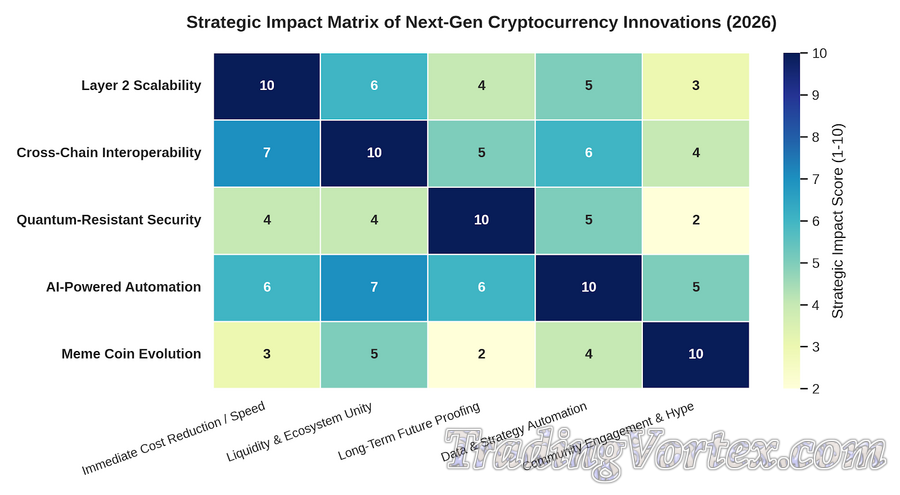 Strategic Impact Matrix of Next-Gen Cryptocurrency Innovations (2026).
Understanding This Visual:
This strategic heatmap is designed to help you quickly identify where each 2026 crypto innovation delivers its maximum value, allowing you to align your portfolio goals with specific asset behaviors. Rather than treating all new tokens equally, you can read this matrix horizontally or vertically to spot key strengths and secondary advantages:
♦ Reading Horizontally (Asset Strengths): Follow an innovation from left to right to see its diverse impact footprint. For instance, while AI-Powered Automation scores a perfect 10 in data and strategy automation, it also holds an impressively strong secondary score of 7 in enhancing cross-chain liquidity and ecosystem unity.
♦ Reading Vertically (Investment Objectives): Look down a single column to find which technology best fulfills your current market needs. If your immediate trading headache is high transaction fees, the Immediate Cost Reduction / Speed column clearly points you directly toward Layer 2 Scalability (scoring a maximum 10). Conversely, if you are looking to hedge against systemic threats a decade down the line, the Long-Term Future Proofing column establishes Quantum-Resistant Security as the clear winner.
◊ How to use this data: Use this matrix as a quick asset-allocation framework. If you are building a balanced portfolio, avoid stacking tokens that only score high in a single vertical column (like pure hype or pure tech). Instead, try to diversify your exposure across different primary scoring sectors, balancing the immediate cost efficiencies of Layer 2s with the long-term defensive insulation of quantum resistance and the active, sentiment-driven momentum of AI or evolving utility meme ecosystems.
Best New Cryptocurrencies to Invest in 2026
Bitcoin Hyper (HYPER) – Fast Layer 2 Bitcoin Transactions
Bitcoin Hyper is designed to fix Bitcoin’s long-standing speed and fee issues. Built as a Layer 2 solution, it enables near real-time BTC transfers with ZK-proof security. Early presale raised over $32 million, showing strong investor confidence.
For traders tired of waiting minutes for confirmations or paying hefty fees, HYPER feels like the upgrade Bitcoin has been waiting for. It’s essentially Bitcoin with a turbo engine, and that’s why many investors are calling it one of the most practical new launches of the year.
LiquidChain (LIQUID) – Cross-Chain Liquidity Powerhouse
Liquidity fragmentation has been a headache for years. LiquidChain solves this by offering unified liquidity across Bitcoin, Ethereum, and Solana, making trading smoother and safer. Developers love it because it opens up cross-ecosystem connectivity, while investors benefit from deeper liquidity pools.
If you’ve ever cursed at bridge delays or hacks, LIQUID is the kind of project that feels like a breath of fresh air. It’s not just about convenience, it’s about creating a safer, more efficient DeFi environment where liquidity flows like water.
Maxi Doge (MAXI) – Meme Coin with Gamified Staking
Meme coins are evolving, and Maxi Doge is leading the charge. It combines meme culture with staking mechanics, offering Proof of Workout and Proof of Winning systems. This means holders can earn rewards while engaging in community-driven activities. It’s fun, it’s cultural, and it’s financial all at once. If Dogecoin was the joke, Maxi Doge is the punchline with utility.
Investors who once dismissed meme coins as pure hype are now realizing that projects like MAXI can blend humor with genuine earning potential.
BMIC Token – Quantum-Resistant Wallet Infrastructure
Quantum computing is creeping closer, and BMIC Token is preparing for it. It powers quantum-resistant security architecture for wallets and enterprise APIs. Burn mechanics tied to quantum workloads add deflationary pressure, while staking and governance expand utility.
For long-term investors, BMIC is like buying insurance against tomorrow’s biggest cybersecurity threat. It’s a niche play, but one that could prove invaluable if quantum breakthroughs arrive sooner than expected.
Divine Ray (DRC) – Blockchain for Spiritual and Social Communities
Divine Ray is more than just a coin: it’s a social media blockchain built on Cosmos, connecting spiritual communities worldwide. Already live, it supports payments, NFTs, and fundraising for conscious change projects. It’s niche, but that’s the point: it taps into communities that value purpose-driven technology.
For investors, it’s a bet on social adoption beyond finance. If you’ve ever thought crypto was too focused on money alone, DRC shows how blockchain can also build communities around shared values.
CoinDepo (COINDEPO) – Governance and Staking Token with High APR
CoinDepo is the native token of a crypto interest platform with over 100,000 users. Holders can earn 19–25% APR by depositing assets like BTC, XRP, and stablecoins. Governance rights give investors a voice in platform decisions, while buyback and burn programs reduce supply over time.
For yield hunters, COINDEPO is a practical choice with strong community backing. It’s the kind of project that appeals to investors who want both passive income and influence over the platform’s future.
Comparison of Best New Cryptocurrencies in 2026
| Cryptocurrency | Core Innovation | Investor Appeal | Risks |
|---|---|---|---|
| Bitcoin Hyper (HYPER) | Layer 2 BTC speed & low fees | Faster, cheaper Bitcoin transactions | Competition with other L2s |
| LiquidChain (LIQUID) | Unified cross-chain liquidity | Seamless trading, developer adoption | Bridge security concerns |
| Maxi Doge (MAXI) | Meme coin + gamified staking | Community engagement, cultural appeal | High volatility, hype-driven |
| BMIC Token | Quantum-resistant wallet security | Future-proof protection, deflationary | Still experimental, adoption risk |
| Divine Ray (DRC) | Social blockchain for communities | Purpose-driven adoption, niche utility | Limited mainstream appeal |
| CoinDepo (COINDEPO) | High APR staking + governance | Yield generation, strong user base | Regulatory scrutiny on high yields |
Best New Cryptocurrencies to Invest in 2026 – Quick Rankings
1. Bitcoin Hyper (HYPER)
Best for: Fast transactions and lower fees
Perfect for investors who want Bitcoin’s security with the speed of modern payment systems.
2. LiquidChain (LIQUID)
Best for: Cross-chain liquidity and DeFi efficiency
Ideal for traders who move assets across multiple blockchains and hate dealing with bridges.
3. Maxi Doge (MAXI)
Best for: Community engagement and gamified staking
Great for those who enjoy meme culture but also want real staking rewards and utility.
4. BMIC Token
Best for: Quantum-resistant security and future-proofing
Suited for long-term investors who worry about quantum computing threats to blockchain.
5. Divine Ray (DRC)
Best for: Social and spiritual community building
Appeals to investors who value purpose-driven projects and niche adoption beyond finance.
6. CoinDepo (COINDEPO)
Best for: High-yield staking and governance rights
Perfect for yield hunters who want passive income and influence over platform decisions.
“This ranking list makes the section more reader-friendly and actionable, helping investors quickly identify which coin aligns with their goals; whether it’s speed, yield, security, or community.”
This section highlights the most promising new cryptocurrencies in 2026, each offering something unique: speed, liquidity, security, culture, community, or yield. For investors, the key is balancing excitement with caution: these projects have potential, but like all crypto, they carry risks.
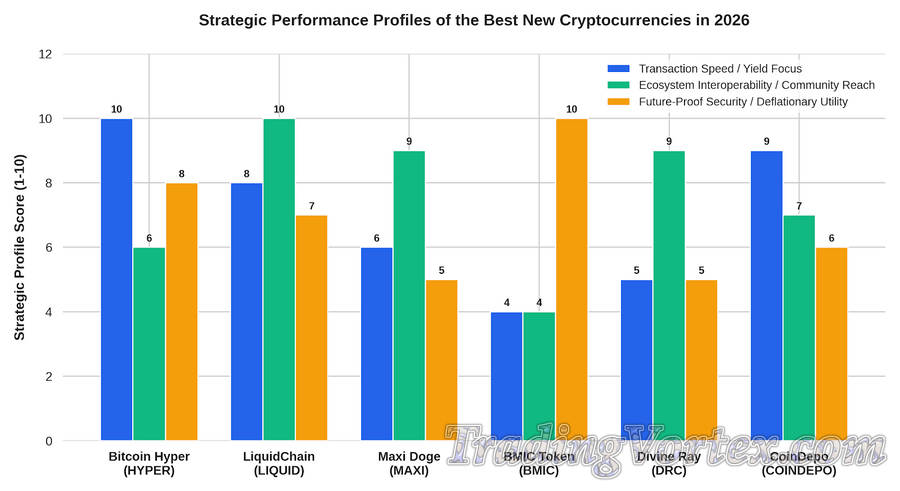 Strategic Performance Profiles of the Best New Cryptocurrencies in 2026.
Understanding This Visual:
This multi-variable bar chart maps out the underlying value profiles of the top six new cryptocurrencies highlighted in our 2026 analysis. Because these assets are built to solve entirely different Web3 challenges, looking at their prices alone doesn't tell the full story. Instead, this visual groups their utility into three easily digestible pillars so you can choose exactly what to prioritize:
♦ Transaction Speed / Yield Focus (Blue Bars): Look here if your investment strategy leans on high throughput or raw passive returns. You can quickly see that Bitcoin Hyper (HYPER) scores a perfect 10 for its Layer 2 engine, closely followed by CoinDepo (COINDEPO) at a score of 9 due to its built-in high-APR platform infrastructure.
♦ Ecosystem Interoperability / Community Reach (Green Bars): This metric tracks how effectively an asset bridges networks or builds social networks. LiquidChain (LIQUID) claims a perfect 10 here for unifying cross-chain liquidity across Bitcoin, Ethereum, and Solana. Meanwhile, culturally driven and niche-social ecosystems like Maxi Doge (MAXI) and Divine Ray (DRC) tie for a powerful second-place score of 9.
♦ Future-Proof Security / Deflationary Utility (Orange Bars): For long-term portfolio preservation, look for high orange bars. BMIC Token (BMIC) leads the entire market with a flawless score of 10 due to its quantum-resistant engineering and workload-based token-burning mechanics.
◊ How to use this data: Treat this chart as an asset-allocation tool to match your risk profile and market outlook. If you believe quantum computing threats will dominate the news cycle soon, you'll want to focus heavily on the orange peak of BMIC. If you prefer generating steady operational cash flow through yield and immediate scalability, you can easily shift your attention to the blue peaks of HYPER and COINDEPO. A well-balanced portfolio can combine assets that peak in entirely different columns to minimize systemic risk.
How to Evaluate the Newest Cryptocurrencies
Analyzing Crypto Tokenomics and Supply Models
Tokenomics is the economic DNA of a cryptocurrency, and ignoring it is like buying a house without checking the foundation. Always start with the basics: total supply, circulating supply, and maximum supply. If only 15 percent of tokens are circulating, expect heavy selling pressure when the rest unlock. Compare market capitalization vs fully diluted valuation (FDV): a large gap means more tokens will flood the market later, dragging prices down.
Equally important is the vesting schedule. Healthy projects lock team and investor tokens for at least a year, then release them gradually. Short cliffs or immediate unlocks are red flags. I once invested in a project that looked promising, only to watch its price crash when insiders dumped after a three-month cliff. Lesson learned: tokenomics isn’t just math, it’s investor psychology coded into the project.
Also pay attention to utility and burn mechanics. Tokens that have real use cases: whether for governance, staking, or powering transactions; tend to hold value better. Burn mechanisms can add deflationary pressure, but only if they’re transparent and consistent. A flashy promise of “massive burns” without clear mechanics is usually marketing fluff.
Measuring Community Adoption and Developer Activity
Crypto thrives on community energy, and a strong community can carry a project through rough markets. Look at social media engagement, Discord activity, and GitHub commits. Meme coins like Doge succeeded because of community hype, while projects like Solana thrived thanks to developer ecosystems.
If you see thousands of followers but no developer activity, be cautious. Fake followers are cheap, but genuine developer contributions are priceless. A project with both hype and substance is far more likely to survive. Think of it like a band: fans can make noise, but without musicians writing new songs, the show won’t last.
Also, check for partnerships and integrations. A project that is being adopted by exchanges, wallets, or DeFi platforms has a much stronger chance of survival. Community energy is great, but without technical adoption, it’s just noise.
Risks and Rewards of Crypto Presale Investments
Presales are tempting: low entry prices, bonus tokens, and exclusive perks. The upside is clear: early investors sometimes see 10x or even 100x returns. The downside is brutal: many presale projects never launch or collapse under sell pressure once tokens hit exchanges.
Before jumping in, check if the team is transparent, if funds are locked, and whether there’s a clear roadmap. Anonymous teams with vague promises are red flags. Presales should be treated like high-risk bets, not guaranteed wins.
I’ve seen friends double their money in weeks, but I’ve also seen others lose everything when a project vanished overnight.
One smart move is to diversify presale investments. Instead of putting all your money into one project, spread it across several. That way, even if one fails, the others may balance out your risk.
Importance of Crypto Regulatory Compliance
Regulation is tightening worldwide, and compliance is becoming a survival requirement. Europe’s MiCA framework requires transparency in token issuance and reporting, while the U.S. and Asia are strengthening rules around stablecoins and DeFi. Projects that ignore compliance risk being delisted or banned, wiping out investor value overnight.
Always check if a project has legal clarity, proper disclosures, and audit reports. Compliance may not sound exciting, but it’s what separates sustainable projects from those that disappear when regulators come knocking. Think of it like building a house: flashy design is nice, but without permits and inspections, the whole thing can be torn down.
For investors, compliance also means easier access to exchanges and institutional adoption. A project that plays by the rules is more likely to attract big money, which can stabilize prices and boost long-term growth.
Quick Comparison Table: Evaluating New Cryptocurrencies
| Evaluation Factor | What to Check | Why It Matters | Red Flags |
|---|---|---|---|
| Tokenomics | Supply, FDV vs Market Cap, vesting schedule, utility, burn mechanics | Determines long-term price stability and sustainability | Huge FDV gap, short unlock cliffs, vague burn promises |
| Community Adoption | Social engagement, developer activity, partnerships | Predicts growth, resilience, and ecosystem integration | Fake followers, inactive devs, no integrations |
| Presale Investments | Team transparency, fund lockups, roadmap, diversification | Offers high ROI potential with manageable risk | Anonymous teams, unclear token use, no roadmap |
| Regulatory Compliance | Legal frameworks, audits, disclosures, exchange listings | Ensures sustainability, institutional adoption, and investor protection | No audits, vague legal status, regulatory warnings |
Bottom line: Evaluating new cryptocurrencies is about balancing excitement with discipline. Tokenomics show if the math works, communities prove if people care, presales offer high risk and reward, and compliance ensures survival. Treat each new coin like buying a car: check the engine, the paperwork, and the roadworthiness. That way, you’ll avoid most scams and find projects with real potential. And remember, in crypto, patience and due diligence often beat chasing the loudest hype.
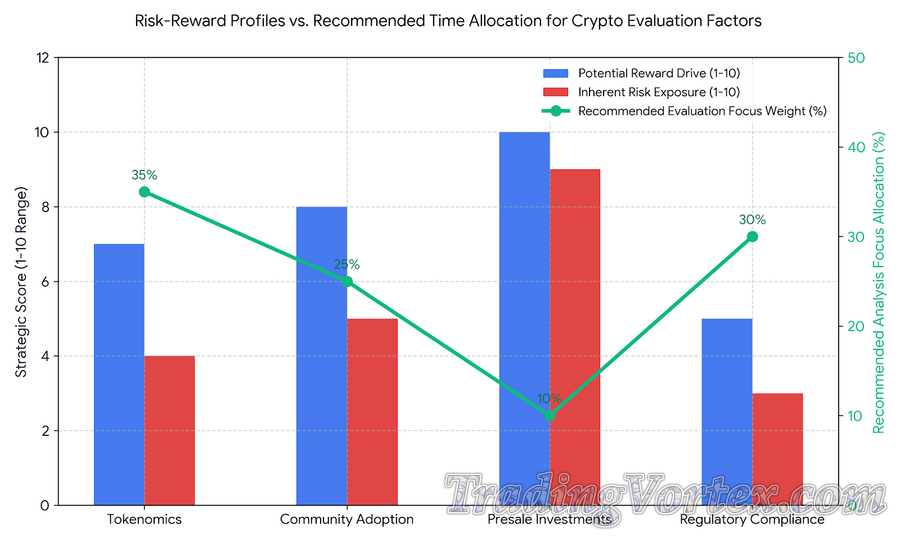 Risk-Reward Profiles vs. Recommended Time Allocation for Crypto Evaluation Factors.
Understanding This Visual:
When you are looking at a brand-new token, it is easy to get overwhelmed by market noise. This dual-axis chart acts as a blueprint to help you divide your limited research time logically based on the structural risk-to-reward ratio of each factor discussed above:
♦ The Bars (Risk vs. Reward Impact): The blue bars measure how much value a single factor adds to the token's long-term upside potential, while the red bars indicate how easily that same factor can crash the project if it fails. Notice Presale Investments: they carry a perfect 10 for potential reward but sit dangerously high with a score of 9 for inherent risk.
♦ The Green Line (Your Optimal Time Budget): The green line guides your daily research discipline. Even though presales offer extreme gains, you should only dedicate roughly 10% of your total analysis time to them due to their predatory downside risk. Instead, you should allocate the lions share of your effort to Tokenomics (35%) and Regulatory Compliance (30%). These areas act as dependable defensive anchors that ensure a project won't mathematically fail or be forced into liquidation by regulatory pressure.
◊ How to use this data: Before putting capital into any emerging cryptocurrency, structure your evaluation checklist around the green line. Spend over half your time auditing supply math and checking for legal frameworks or code audits. By making sure these structural pillars score low on the red risk index first, you can safely pursue the high-reward community hype without accidentally walking into a market trap.
Challenges and Risks in New Crypto Investments
Crypto Market Volatility and Speculative Bubbles
Volatility is the defining feature of crypto, and in 2026 it is as intense as ever. Market capitalization swings between $2.4 trillion and $2.7 trillion, influenced by ETF inflows, macroeconomic cycles, and shifting investor sentiment. Prices can double in weeks or collapse just as quickly, often with little warning. Speculative bubbles form around presales, meme coins, or hyped narratives, drawing in retail investors who fear missing out. When the bubble bursts, latecomers are left holding heavy losses.
If you’ve ever bought a token because “everyone else was talking about it,” you know how quickly hype can turn into regret. The lesson is simple: volatility is not a bug in crypto, it’s a feature. Treat it as part of the game, not a surprise, and avoid chasing hype without understanding the fundamentals.
Regulatory Uncertainty Across Global Markets
Regulation is improving but remains fragmented. The EU’s MiCA framework is setting standards for transparency and investor protection, while the U.S. is still wrestling with enforcement actions and classification debates. Asian markets are experimenting with sandbox environments, encouraging innovation but leaving investors uncertain about long-term rules.
This patchwork of regulations creates challenges for projects and investors alike. What is legal in Europe may be restricted in Asia, and a sudden enforcement action in the U.S. can wipe out liquidity overnight.
For investors, this means staying alert to jurisdictional risks. A project ignoring compliance may look profitable today but could vanish tomorrow if regulators intervene.
Crypto Security Threats Including Quantum Computing Risks
Security remains a major challenge. Smart contract vulnerabilities continue to cause losses, especially in DeFi protocols where billions are locked. Even audited contracts can harbor bugs, and bridge exploits remain common. Hacks in 2026 have already cost investors billions, reminding everyone that technical risk is real.
Looking ahead, quantum computing is a looming threat. Analysts warn that Bitcoin’s current cryptography could be cracked within the next decade, making quantum-resistant projects more attractive.
For investors, this is a reminder that security isn’t static: it evolves with technology. Coins that adapt to new threats will survive longer, while those that ignore them may face extinction.
Liquidity Challenges in Emerging Projects
Liquidity is often overlooked but critical. New tokens may launch with thin trading volumes, making it hard to enter or exit positions without moving the market. Institutional adoption is helping stabilize liquidity for major coins, but smaller projects still struggle. A lack of liquidity can trap investors, forcing them to sell at steep discounts or wait for buyers who never come.
If you’ve ever tried to offload a low-cap token only to realize there are no buyers, you know the frustration. Always check trading volume, exchange listings, and liquidity pools before committing.
A project with strong fundamentals but no liquidity is like owning a house in the desert: you may have value on paper, but good luck finding someone to buy it.
Comparison Table: Challenges and Risks in New Crypto Investments
| Risk Factor | Current Situation (2026) | Impact on Investors | Mitigation Strategy |
|---|---|---|---|
| Volatility | Market swings tied to ETFs and macro cycles | Sudden gains or losses | Diversify, avoid chasing hype |
| Regulatory Uncertainty | EU clarity vs fragmented U.S./Asia rules | Risk of delisting or bans | Focus on compliant projects |
| Security Threats | Smart contract bugs, bridge exploits, quantum risk | Loss of funds, systemic risk | Use audited platforms, explore quantum-resistant coins |
| Liquidity Challenges | Thin volumes in new projects | Hard to exit positions | Check trading volume, stick to reputable exchanges |
Bottom line: New crypto investments in 2026 are exciting but risky. Volatility, regulation, security, and liquidity all demand attention. If you treat crypto like a high-speed car, remember: it can take you far, but only if you respect the brakes, the rules of the road, and the fuel that keeps it running. Smart investors balance curiosity with caution, and that’s how they survive the wild ride.
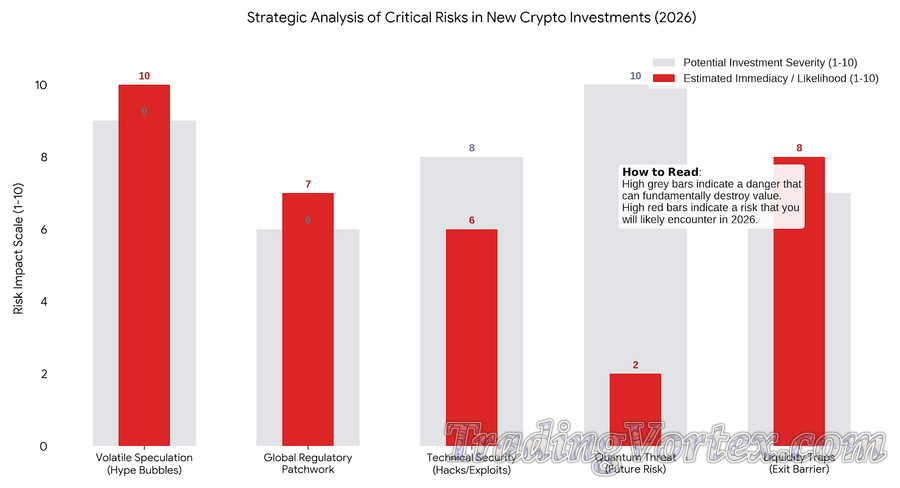 Strategic Analysis of Critical Risks in New Crypto Investments (2026).
Understanding This Visual:
This grouped bar chart is designed to help you prioritize your risk management efforts by separating how dangerous a risk factor is (its Severity) from how likely or immediate it is in 2026 (its Immediacy). To use this chart effectively, focus on the relationship between the two bars within each category:
♦ The Immediate and High-Impact Threats (Volatile Speculation): Look at Volatile Speculation (Hype Bubbles). Here, the red immediacy bar is at its peak (10), indicating you are almost guaranteed to face intense volatility in 2026. Because the grey severity bar is also high (9), it warns you that this volatility can be catastrophic if you chase hype without fundamentals.
♦ The Strategic Future-Proofing (Quantum Threat): Notice the dramatic contrast in Quantum Threat. Its grey severity bar is a perfect 10, suggesting it could fundamentally destroy asset value. However, its red immediacy bar for 2026 is lowest (2). This visual guides you to treat this risk not as an immediate panic but as a long-term due diligence item; prioritizing projects that show early awareness of quantum-resistant cryptography.
◊ The Trap (Liquidity Barriers): Notice Liquidity Traps. This combination reveals a highly probable risk (8 Immediacy) that can be severe (7 Severity). If you are investing in emerging or low-cap projects, this chart warns you that the danger of being unable to exit your position is just as immediate as market volatility.
Future Outlook for New Cryptocurrencies
Expansion of Tokenized Assets in Finance
Tokenization is quickly becoming the star of 2026. Tokenized treasuries, funds, and commodities are gaining traction because they solve real institutional problems: settlement delays, operational inefficiencies, and capital lockups. According to Forbes and Silicon Valley Bank, tokenized real-world assets are expected to grow faster than purely native crypto products because they directly improve financial infrastructure.
Banks and asset managers are experimenting with tokenized bonds and equities, while governments are exploring tokenized debt issuance to streamline capital markets. This shift is not just about efficiency, it is about accessibility. Tokenization allows fractional ownership, meaning retail investors can buy slices of assets that were once reserved for institutions.
Imagine owning a fraction of a government bond or a piece of a commercial property, all managed seamlessly on-chain. For investors, this means new cryptocurrencies tied to tokenization could enjoy strong demand from banks, asset managers, and enterprises. Think of it as crypto moving from speculative trading into the plumbing of global finance.
Mainstream Adoption of Crypto Payments
Stablecoins are no longer fringe: they are becoming the internet’s dollar. In 2026, they are powering remittances, corporate treasury operations, and everyday payments. The stablecoin transaction volumes are surging, with enterprises integrating them into cross-border settlement and payroll systems.
Retail adoption is also accelerating. E-commerce platforms are quietly integrating stablecoin payments, and some employers are experimenting with paying salaries in stablecoins to reduce cross-border friction. The beauty of this trend is that many end users won’t even realize they are using crypto, since stablecoins fade into the background as financial infrastructure.
For investors, this signals that coins supporting stablecoin ecosystems or payment rails could see steady adoption.
Of course, challenges remain. Governance models for stablecoins are under scrutiny, and regulators are pushing for tighter oversight. But the trajectory is clear: stablecoins are becoming the backbone of digital payments, and projects that support this infrastructure are positioned for long-term relevance.
Long-Term Potential of Web3 and Decentralized Finance
Web3 adoption is accelerating, and it is giving new cryptocurrencies fertile ground to grow. Decentralized applications are moving beyond hype into real-world use cases like gaming, social media, and supply chain management. DeFi continues to evolve, offering more sophisticated lending, staking, and yield products.
AI integration is also reshaping digital commerce, with predictive trading and automated smart contracts becoming mainstream. Imagine a decentralized marketplace where AI agents negotiate trades on your behalf, or a social platform where creators earn directly from their communities without intermediaries. These are no longer futuristic ideas; they are happening now.
For investors, this means that coins aligned with Web3 ecosystems have a better chance of long-term survival. Blockchain is shifting from experimentation to enterprise-grade deployment, making it the backbone of digital financial markets. The projects that thrive will be those that combine technical innovation with user-friendly experiences, bridging the gap between crypto natives and mainstream users.
Comparison Table: Future Outlook for New Cryptocurrencies
| Trend | Key Highlights | Investor Opportunities | Risks |
|---|---|---|---|
| Tokenized Assets | Treasuries, funds, commodities on-chain | Institutional demand, efficiency gains, fractional ownership | Regulatory frameworks still evolving |
| Crypto Payments | Stablecoins as “internet’s dollar” | Everyday adoption, corporate treasury use, e-commerce integration | Governance and compliance challenges |
| Web3 & DeFi | Gaming, social, AI-driven DeFi | Ecosystem growth, new utility tokens, creator economy | Tech maturity, user onboarding hurdles |
Bottom line: The future of new cryptocurrencies lies in becoming invisible infrastructure rather than flashy speculation. Tokenization will anchor them in finance, stablecoins will power payments, and Web3 will expand their utility. For investors, the smartest play is to look for projects that solve real problems and integrate seamlessly into existing systems, because those are the ones most likely to thrive in the years ahead.
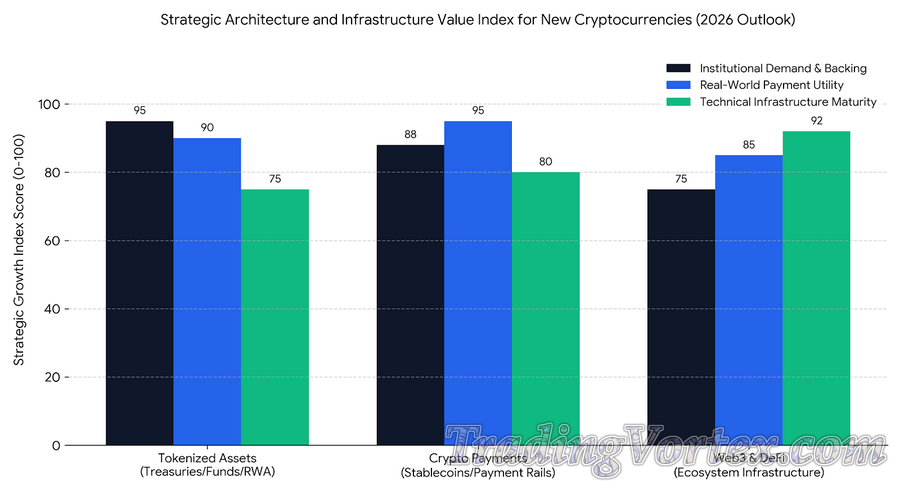 Strategic Architecture and Infrastructure Value Index for New Cryptocurrencies (2026 Outlook).
Understanding This Visual:
As the cryptocurrency sector transforms into an invisible financial utility, your approach to parsing project potential needs to transform with it. This strategic performance index compares the three massive structural trends shifting the 2026 macro landscape, breaking down where their true power lies across three core operational metrics:
♦ Institutional Demand & Backing (Dark Navy Bars): This metric evaluates how heavily traditional banks, regulatory sandbox protocols, and global asset managers are funding a sector. Notice that Tokenized Assets (Real-World Assets) top this index with a score of 95, validating that institutional plumbing is rapidly shifting to public or hybrid ledgers.
♦ Real-World Payment Utility (Blue Bars): This measures immediate, non-speculative transactional adoption. Crypto Payments (Stablecoins) command an exceptional score of 95, showing that digital fiat rails have successfully detached from pure trading environments and entered corporate treasury operations, payroll pipelines, and cross-border settlement architectures.
♦ Technical Infrastructure Maturity (Green Bars): This tracks the growth of developers building decentralized infrastructure and automated code logic. Web3 & DeFi claim the clear lead here at 92, showing that advanced smart contracts, AI-driven automation systems, and modular developer kits have achieved enterprise-grade resilience.
◊ How to use this data: When selecting new crypto networks or utility tokens for your long-term watch list, match the token's primary use case against this index. If you are tracking a project that targets corporate clients, it must integrate deeply with tokenized assets or stablecoin payment rails to capture the massive institutional backing shown on the left. Conversely, if your focus is capturing technical growth and native ecosystem applications, target projects building directly into the high-performing Web3 & DeFi infrastructure sector. Diversifying your focus across the absolute highest peak of each column ensures you capture fundamental value instead of seasonal hype cycles.
Conclusion: Should You Invest in the Newest Cryptocurrency?
Summary of the Most Promising New Cryptocurrencies in 2026
The year 2026 has introduced several standout projects:
- Bitcoin Hyper (HYPER) for faster Bitcoin transactions.
- LiquidChain (LIQUID) enabling unified cross-chain liquidity.
- BMIC Token pioneering quantum-resistant security.
- Maxi Doge (MAXI) evolving meme coins into gamified staking ecosystems.
- Divine Ray (DRC) building blockchain communities around social and spiritual values.
- CoinDepo (COINDEPO) offering high-yield staking and governance rights.
These projects reflect broader market themes: tokenization of real-world assets, stablecoin adoption in payments, and Web3 integration into daily life. Analysts predict tokenized assets could grow 10x to $400 billion by 2026, while stablecoins may surpass $500 billion in market cap, becoming the backbone of global payments.
Balancing Opportunities with Risks in Crypto Investments
Opportunities:
- High growth potential: Early adoption of new tokens can deliver outsized returns.
- Institutional adoption: ETFs, tokenized assets, and corporate holdings are stabilizing liquidity.
- Innovation-driven utility: AI-powered projects, Layer 2 scaling, and cross-chain solutions solve real problems.
Risks:
- Volatility: Prices can swing wildly, with Bitcoin options markets pricing equal odds of $50k or $250k by year-end 2026.
- Regulatory uncertainty: Rules differ across regions, and sudden enforcement can wipe out liquidity.
- Liquidity traps: Emerging tokens may lack buyers, making exits difficult.
- Security threats: Smart contract bugs and quantum computing risks remain.
The lesson is clear: new crypto investments are high-risk, high-reward plays. Treat them like venture capital bets, not guaranteed wins.
Building a Long-Term Crypto Investment Strategy
- Diversify allocations: Keep exposure to new tokens small (5–10% of portfolio), while maintaining positions in established assets.
- Focus on fundamentals: Prioritize projects with strong tokenomics, transparent teams, and clear utility.
- Monitor regulation: Favor projects aligned with frameworks like MiCA in Europe, which provide compliance clarity.
- Rebalance regularly: Take profits from winners, cut losses early, and reinvest in vetted opportunities.
- Think long-term: The real value lies in projects that integrate into finance and commerce, not short-lived hype.
Quick Comparison: Should You Invest?
| Factor | Opportunity | Risk | Best Approach |
|---|---|---|---|
| Tokenization | Access to $664T asset market | Regulatory hurdles | Invest in compliant projects |
| Stablecoins | Everyday payments, treasury use | Governance scrutiny | Favor regulated issuers |
| Web3 & AI | New ecosystems, automation | Tech maturity issues | Select projects with adoption |
| Presales | High ROI potential | Rug pulls, collapse | Diversify, limit exposure |
Final thought: If you enjoy the thrill of discovery, allocate a small, disciplined portion of your portfolio to the newest cryptocurrencies. Focus on projects solving real problems, keep risk controls in place, and remember that patience and due diligence often beat chasing hype. In 2026, crypto is no longer optional—it is becoming part of mainstream finance, and the newest coins are where innovation lives.
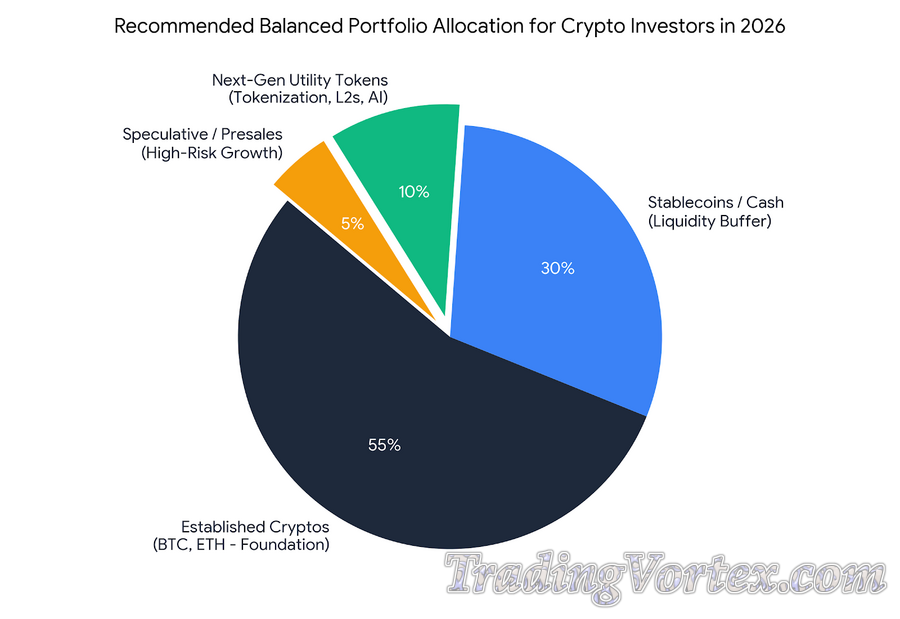 Recommended Balanced Portfolio Allocation for Crypto Investors in 2026.
Understanding This Visual:
To translate the core takeaway of this final section into a practical, actionable strategy, this pie chart provides a visual blueprint for a balanced digital asset portfolio in 2026. Rather than going "all in" on unproven assets, you can use this breakdown to see how the newest market entries fit alongside your safer capital holdings:
♦ The Anchor (55% - Dark Navy): The absolute majority of your digital assets should reside in established blue-chip foundations like Bitcoin and Ethereum. This core ensures your portfolio survives market-wide macro corrections and benefits from ongoing institutional ETF flows.
♦ The Defensive Shield (30% - Blue): Keeping a substantial slice in cash or fully compliant stablecoins serves two purposes. First, it completely insulates your portfolio from the extreme volatility swings mentioned by analysts. Second, it gives you immediate liquidity to capitalize on market dips without being forced to liquidate long-term assets.
♦ The Innovation Core (10% - Green): This represents your calculated entry into the newest cryptocurrencies highlighted throughout this guide. This allocation focuses specifically on foundational utilities that solve structural finance problems: such as Layer 2 protocols (e.g., Bitcoin Hyper), interoperability layers (LiquidChain), or asset-tokenization engines.
♦ The Speculative Perimeter (5% - Orange): This tiny, controlled slice is where you can safely absorb the high risk of early-stage presales, experimental utility ecosystems, or high-volatility cultural meme projects (like Maxi Doge).
◊ How to use this data: Use this chart to conduct a quick audit of your current digital asset exposures. If your portfolio looks like an inverted version of this chart: where high-risk presales or micro-cap projects dominate your capital allocations; you are exposing yourself to severe liquidation risks. To protect and grow your capital in 2026, rely on due diligence, trim your top-heavy speculative assets during market rallies, and systematically rebalance back to these proportional, risk-managed boundaries.
FAQs: Newest Cryptocurrency to Invest In (2026)
What makes new cryptocurrencies in 2026 different from older ones?
New coins today are not just hype tokens. Many are tied to tokenized real-world assets, AI-driven trading platforms, or quantum-resistant security models. Unlike the early days when coins were mostly speculative, 2026 projects are increasingly integrated into mainstream finance, with institutional adoption and regulatory frameworks shaping their growth. This means they are designed not only for speculation but also for solving real-world problems like faster payments, secure storage, and cross-chain liquidity.
Are new cryptocurrencies riskier than established ones?
Yes, they carry higher volatility, liquidity challenges, and regulatory uncertainty. Prices can swing wildly, and thin trading volumes make it hard to exit positions. Hacks and rug pulls are still common in presales. That said, the upside potential is bigger, especially if you catch a project early that later gains institutional traction. Think of it like investing in a startup: the risk is high, but the reward can be transformative if the project succeeds.
How do I evaluate whether a new cryptocurrency is worth investing in?
Check four essentials:
♦ Tokenomics: Look at supply, vesting schedules, and utility.
♦ Community and developer activity: Active GitHub commits and strong social engagement matter.
♦ Presale transparency: Avoid anonymous teams or unclear roadmaps.
♦ Regulatory compliance: Projects aligned with frameworks like Europe’s MiCA are safer bets.
If a project scores well on these four, it’s worth a closer look.
What role does regulation play in new crypto investments?
Regulation is now a major driver of legitimacy. Clearer rules around exchanges, stablecoins, and tax reporting are attracting institutional investors. The downside is compliance costs and slower innovation. Different countries still take different approaches, so investors must track jurisdictional risks carefully. A project that is compliant in Europe may face hurdles in the U.S. or Asia, so always check where it is legally supported.
Can new cryptocurrencies really deliver high ROI in 2026?
They can, but it’s not guaranteed. ROI depends on macro cycles, institutional inflows, and project fundamentals. Spot ETFs and tokenized assets are creating structural demand, while presales can deliver outsized returns if the project survives. Treat them like venture capital bets: high risk, high reward. Remember, for every coin that skyrockets, several fail quietly.
What are the biggest opportunities in new cryptocurrencies right now?
♦ Tokenized treasuries and funds: Bringing traditional finance on-chain.
♦ Stablecoin ecosystems: Powering global payments.
♦ Web3 and DeFi projects: Expanding into gaming, social media, and AI-driven automation.
These areas are attracting both retail and institutional interest, making them strong candidates for long-term adoption.
How should I build a strategy around new crypto investments?
♦ Keep exposure small (5–10% of portfolio).
♦ Diversify across several projects instead of betting on one.
♦ Take profits early when hype-driven gains appear.
♦ Stick to projects with clear utility and compliance.
Think of it like balancing your diet: a little spice adds flavor, but too much can burn.
Bottom line: New cryptocurrencies in 2026 are more sophisticated than ever, blending finance, tech, and community. They can deliver life-changing returns, but they also carry serious risks. If you treat them like speculative venture bets, do your homework, and keep allocations modest, you’ll enjoy the upside without being crushed by the downside.